
Heat pump, solar or gas? Here is how the three compare on running costs, upfront price and site requirements, and which one actually suits a Perth home.
Heat Pump vs Solar vs Gas Hot Water Systems
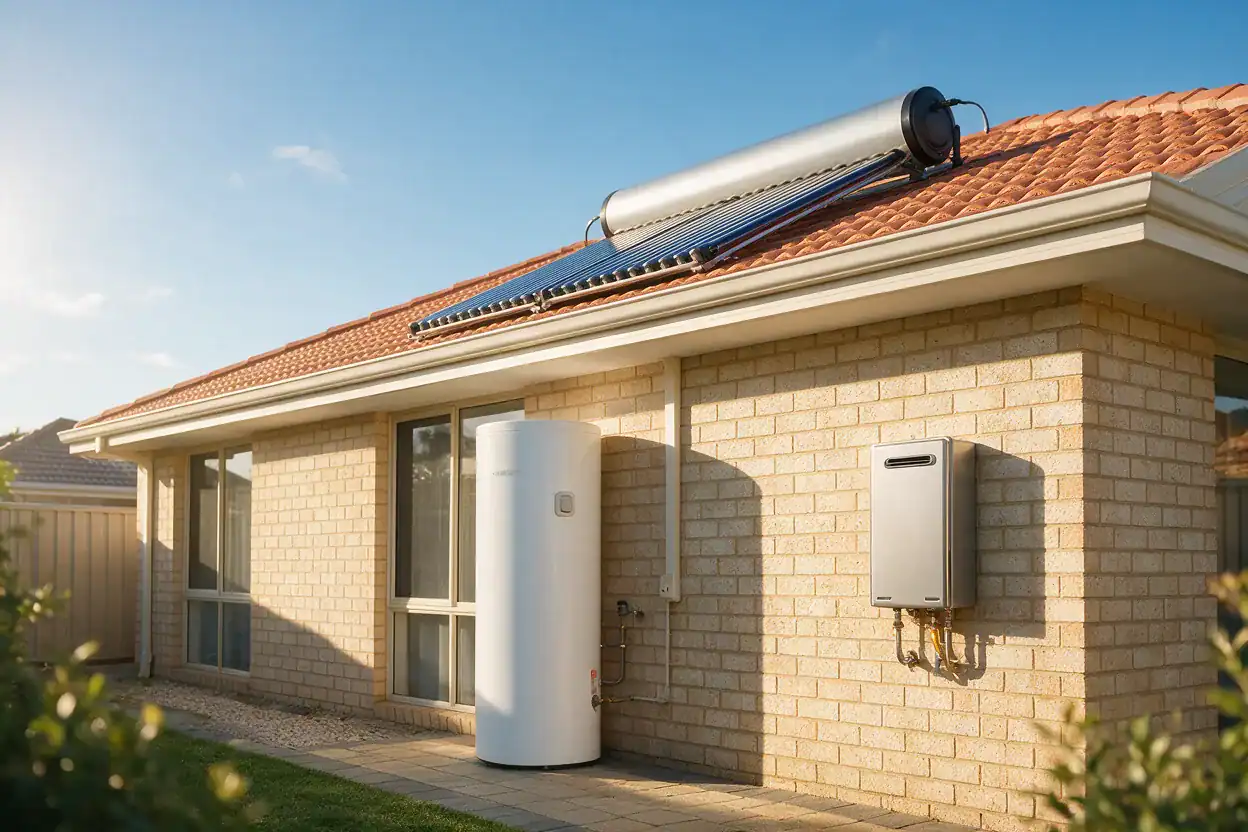
Heat pump hot water systems offer the best overall balance of low running costs and high energy efficiency for most Australian homes. They use up to 75% less electricity than a standard electric unit by drawing warmth from the air, and they attract generous government rebates that solar shares and gas does not.
But Perth is not like most of Australia. With more than eight hours of sunshine a day and a Mediterranean climate of mild winters and hot, dry summers, the maths here looks different.
Plenty of Perth homes also sit on established gas network connections, which shifts the upfront cost picture again.
Heat Pump vs Solar vs Gas at a Glance
| Heat Pump | Solar Hot Water | Gas | |
|---|---|---|---|
| Running cost per year | $250 to $400, or $50 to $100 with rooftop solar | $150 to $300 | $500 to $800 |
| Upfront cost | Moderate to high | Highest | Lowest if gas is connected |
| Efficiency | Up to 3x more efficient than gas | Cuts energy use by 50 to 90% | Lowest of the three |
| Site requirements | Outdoor space and good airflow | Clear north facing roof | Existing gas supply |
| Rebates | Federal STCs | Federal STCs | None |
| Best suited to | Most Perth homes | Larger households with roof space | Homes with existing gas connections |
Prices here are product price only. Installation is quoted per job.
Not Sure Which System Suits Your Property?
We install all three across Perth, so there is no pushing you towards one option. We look at your roof, gas supply and outdoor space, then quote supply and installation upfront.
How Heat Pump Hot Water Systems Work
A heat pump hot water system works much like a reverse cycle air conditioner running backwards. Rather than generating heat, it runs a compressor to pull warmth out of the surrounding air and transfer heat into a storage tank.
Because heat pumps work by moving heat rather than making it, an electric heat pump is highly efficient, using up to 75% less electricity than a standard electric element.
What Heat Pumps Cost to Run
Expect around $250 to $400 a year, with heat pump systems cutting hot water energy consumption by roughly 60 to 70% against a conventional electric system.
If you already have solar panels, that drops sharply. Good heat pumps can be timed to run during peak rooftop solar production, bringing running costs down towards $50 to $100 a year.
Why Heat Pumps Suit the Perth Climate
Heat pumps are sometimes criticised for losing efficiency in the cold, a fair concern in an alpine town and largely irrelevant here. Quality units hold efficiency at low temperatures, running from -7°C to 43°C, and Perth winters never approach the bottom of that range.
What they need is space and air. The unit sits outside, needs good airflow to keep extracting heat, and is not silent, so positioning matters.
We do not stock heat pumps in our standard range, but we supply and install them on request.
How Solar Hot Water Systems Work
Solar hot water systems use roof mounted solar collectors to heat water directly from sunlight before it reaches your hot water tank. Because the sun does not shine on demand, every system pairs with an electric or gas booster for cloudy days and heavy use.
With eight hours of sunshine a day, Perth is one of the country’s strongest solar power markets for water heating.
What Solar Costs to Run
Solar carries the lowest running costs of the three at roughly $150 to $300 a year. Energy efficient by design, solar hot water systems can cut water heating consumption by 50 to 90%, with a longer lifespan than most people expect.
The trade off is the upfront investment, highest of the three. Our Solahart 181L starts at $3,900, the Rheem 52D300 at $5,150, and the Solahart 302L at $5,900.
What Your Roof Needs
Solar is the fussiest of the three about the property. You need clear, unshaded, north facing roof space, with the structure to carry the collectors and, on roof mounted models, the water storage tank. A neighbouring two storey build, a large gum or a south facing pitch can rule it out.

How Gas Hot Water Systems Work
Gas hot water systems burn natural gas, either on demand through a continuous flow unit or by keeping a storage tank hot. Where a home already has gas connections, it is comfortably the cheapest of the three to replace.
One limitation catches people out. Continuous flow units still need mains electricity for ignition and electronic controls, so they will not run during a blackout.
What Gas Costs to Run
Gas systems are the most expensive of the three to run at roughly $500 to $800 a year, exposed to gas prices that have climbed steadily. Heat pumps are up to three times more efficient at the same job.
Gas has the smallest initial investment and the largest lifetime cost. Over ten years, the lower running costs of a heat pump or solar usually swallow that saving.
When Gas Is Still the Right Call
Plenty of situations still suit gas, and we install a lot of it across Perth:
- The property already has gas supply and a working flue
- There is no outdoor space for a heat pump, and no north facing roof for solar
- Upfront budget is the constraint
- You need high simultaneous demand from a compact wall mounted unit
Our instant gas hot water systems suit smaller footprints, while gas storage hot water systems handle steady demand.

Which Hot Water System Should You Choose?
Most Perth homes with outdoor space: A heat pump. Best balance of energy savings, efficiency and rebate support, and our mild climate suits it all year.
Larger households with a clear north facing roof: Solar hot water. Lowest running costs of any option, with the strongest payback where daytime use is high.
Homes with gas connected and a tight budget: Gas. Cheapest to install, but budget for higher energy bills every year you own it. Where there is no gas at all, an electric storage hot water system is the low cost fallback, though it costs more to run than anything here.
Homes with existing rooftop solar PV: A heat pump, comfortably. Timed to run on your own solar power, running costs fall towards $50 to $100 a year and household energy costs barely move.
The right hot water system comes down to your roof, gas supply, outdoor space and how much hot water you use.
No article can tell you which without seeing the property, and anyone giving you a firm answer over the phone is guessing.
What Installation Involves in Perth
Whichever way you go, this is licensed work:
- Gas hot water installation must be done by a licensed gas fitter, and new gas lines, flueing or ventilation may be required. Our gas fitting team handles that as part of the job.
- Heat pump systems must be installed to Australian standards, with adequate clearance and airflow.
- Solar requires a structural roof assessment and correct collector orientation.
- Any changeover can trigger compliance items such as tempering valves and safe trays.
We hold plumbing licence PL 9874 and gas licence GF 014602, with same day installation in most cases.
Need a New Hot Water System but Unsure Which? Contact Proud Plumbing Today!
Heat pump, solar or gas, the right answer depends on your roof, your gas supply, your outdoor space and how much hot water your household actually gets through.
We install all three across Perth, so there is no pushing you towards one option over another.
Give us a call and we will look at the property, talk through running costs and rebates for your situation, and give you a firm quote on supply and installation.
Licensed plumbing (PL 9874) and gas fitting (GF 014602), with same day installation available in most cases.
If you are without hot water right now, say so when you call and we will prioritise the job.
